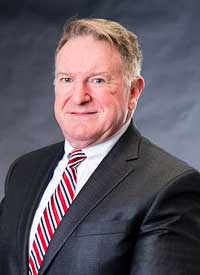
What actually decides an election — the candidate, the money, or the message? Chapman
Rackaway, Ph.D., has spent his career inside that question, not just studying it from
a distance.
Before he was a professor, Rackaway worked in political campaigns: the kind of hands-on
political combat most people only see from the outside. That experience shapes everything
he teaches now: Political Campaign Management, Campaign Finance, Media Politics, and
State and Local Government. His classes aren't theoretical. Students learn how campaigns
win and lose, and increasingly, how professional electioneering is reshaping democracy
itself.
Rackaway has extensive experience at chairing political science departments, and each
time, he's asked the same question: how do we build a program students actually want
to be part of? At Radford, and as someone who still teaches, still writes, and still
wants students to walk away from his classes able to think for themselves about power,
he has built a program dedicated to engaging students in thinking, researching, and
sharing political solutions -not just identifying problems.
He's also spent over two decades pushing the idea that democracy only works if people
show up for it. Since 2003, he's been part of a national effort — the American Democracy
Project — helping campuses across the country turn civic engagement into something
students do, not just read about.
Rackaway is the author of Civic Failure and its Threat to American Democracy: Operator Error, and co-editor of books on party politics and the Trump presidency, among others —
but his real interest isn't in writing about politics from the sidelines. It's in
helping students understand it well enough to shape it themselves.
Why study political science? For Rackaway, it comes down to this: elections and government
decide who gets power and what they do with it — and understanding how that works
is the first step to having a say in it yourself.
Rackaway holds a Ph.D. in Political Science and has taught and led departments at
Fort Hays State University, the University of West Georgia, and Radford University.
Read more of his work at chapmanrackaway.com.